Portfolio as product
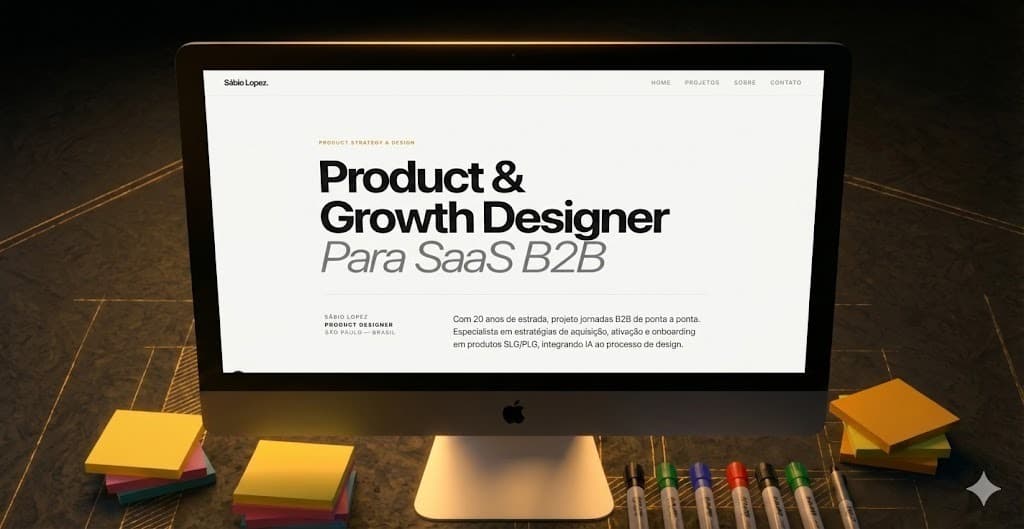
Construction of an authorial portfolio treated as a real product system, involving discovery, structuring, design, code, and deploy with AI support.
The project was conceived with a double function: to serve as a real material for professional positioning and to function as a practical laboratory for the application of artificial intelligence throughout the entire product cycle. The proposal was not to communicate seriousness through discourse, but to demonstrate it through structural decisions, narrative coherence, content architecture, and technical implementation.
This is the fourth portfolio experiment using AI as support. In this version, the entire process was conducted end-to-end with AI support: research, narrative definition, content structuring, modular organization of cases, code generation and adjustment, and the deployment process. The project was launched in MVP format, with progressive content evolution.
The Challenge
The challenge wasn't to redesign a portfolio — it was to put Artificial Intelligence to the test across a complete product process, from discovery to deploy. The portfolio itself became the proving ground: validating tools, pushing limits, and integrating AI as a structural part of the method — not just a one-off accelerator.
🧩 AI-driven Discovery
From scattered experiences to a coherent narrative. Organizing years of projects and decisions into a story that made sense — using LLMs to structure content, synthesize patterns, and explore different narrative forms without losing consistency.
🎨 Design as a system, not a screen
Building a visual identity with AI, without giving up intent. Expressing the duality between data and narrative in a coherent visual language — exploring image generation, style variations, and visual references with AI, while maintaining aesthetic control and conceptual clarity.
🚀 Deploy as part of the experiment
Shipping without a traditional development workflow. Running the full build using AI-based tools — code generated and iterated via Antigravity, integrated with GitHub for continuous publishing. The goal: to validate, in practice, whether an AI-assisted end-to-end flow is truly viable.
Structural Strategies
The portfolio was treated as a real product system, using AI throughout the cycle to demonstrate seriousness through architecture and technical implementation decisions.
Execution Guidelines
Product before showcase
Treated as an evolving product, with MVP logic and a backlog of continuous improvements.
Seriousness through structure
Credibility built through architecture, content organization, and visual consistency.
AI as a means of construction
Support tool that requires curation, refinement, and constant iteration.
Progressive launch
Site initially published with a solid structure, evolving content in layers.
Design Process
Strategic framing
Defining the positioning objective as a Growth/Product Designer with process mastery.
Modular structuring
Creation of a standardized template for projects, ensuring narrative and visual consistency.
AI in multiple stages
Application of AI for content generation, idea organization, and coding support.
Technical implementation
Use of Antigravity (Gemini) for code generation, structural adjustments, and deployment execution.
What this project taught me
AI requires structure
Artificial intelligence does not eliminate technical complexity; it requires structure, practice, and continuous curation.
Systemic view
Taking on implementation stages drastically broadens understanding of how the product actually works.
Product stance
Treating personal projects with the rigor of a real product significantly strengthens professional positioning.