7-day trial journey redesign
Redesign of the 7-day trial experience to transform a limited period into an activation engine — even in the face of technical and cognitive barriers.
The company used a free 7-day trial as its primary self-service channel, but activation depended on technical and non-intuitive actions.
At the same time, there was a misalignment between product usage and plan understanding, making value perception difficult.
The resulting scenario:insufficient time for explorationcomplexity blocking activationpoorly understood value
Business ContextLow self-service conversion and high dependence on SDRs indicated a gap between acquisition, activation, and monetization. The quarter's goal was to increase PLG efficiency, raising trial conversion and improving CAC/LTV.
Project ScopeAction on the trial journey: onboarding, technical setup, activation (Aha), and conversion (checkout and plans).
The Challenge
Activation depended on a set of critical actions that were not evident in the journey — and that, in some cases, required technical knowledge to be executed.
Technical setup as entry barrier
Digital certificate configuration was mandatory to access key features but involved a sensitive, unfamiliar process with high perceived user risk.
Insufficient time for organic discovery
The 7-day period did not allow for free exploration. Without clear direction, users browsed superficially and abandoned before reaching the product's minimum value.
Misalignment between usage and value proposition
The relationship between used features and available plans was not evident, making it difficult to understand the value delivered and directly impacting conversion.
Activation and Monetization Architecture
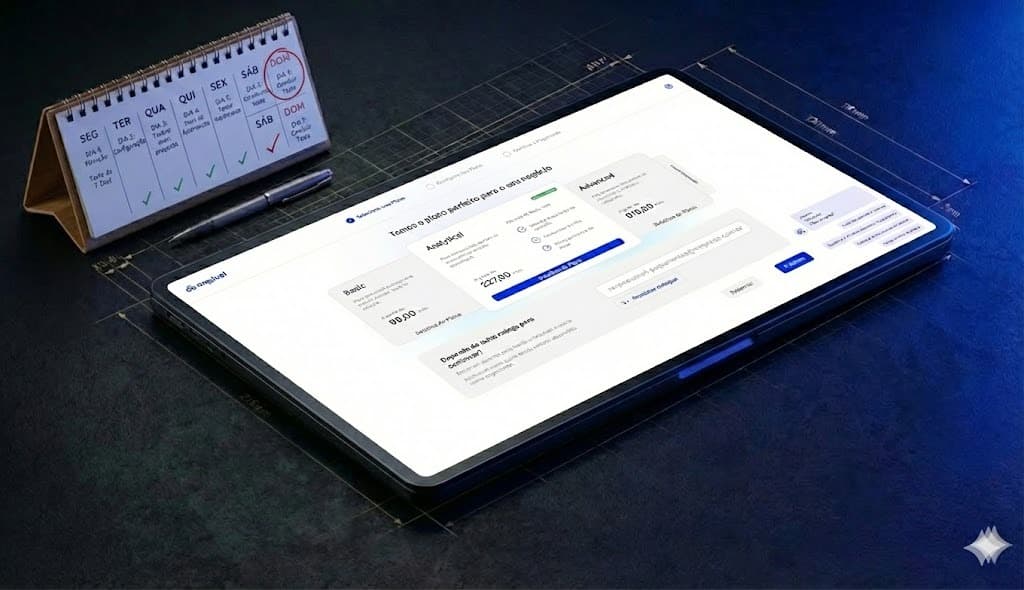
The solution combined changes throughout the journey — inside and outside the product — to align usage, understanding, and perceived value within the trial period.
Activation stopped being a consequence of exploration and became a guided flow, acting directly at the intersection of activation and monetization.
Solution Levers
Feature review and plan alignment
Features were reorganized and re-explained to clearly reflect what each plan delivered. The experience began to directly connect feature usage with the pricing model presented at the end of the journey.
Activation journey structuring
The flow was redesigned to prioritize critical actions and reduce superficial exploration, guiding the user to the product's minimum value within the available time.
Support and education layers throughout the journey
Support mechanisms were introduced to reduce technical and cognitive friction: guided onboarding inside the product, email communication throughout the trial, consultative chat support, and decision-support elements such as simulators and volumetry references.
Design Process
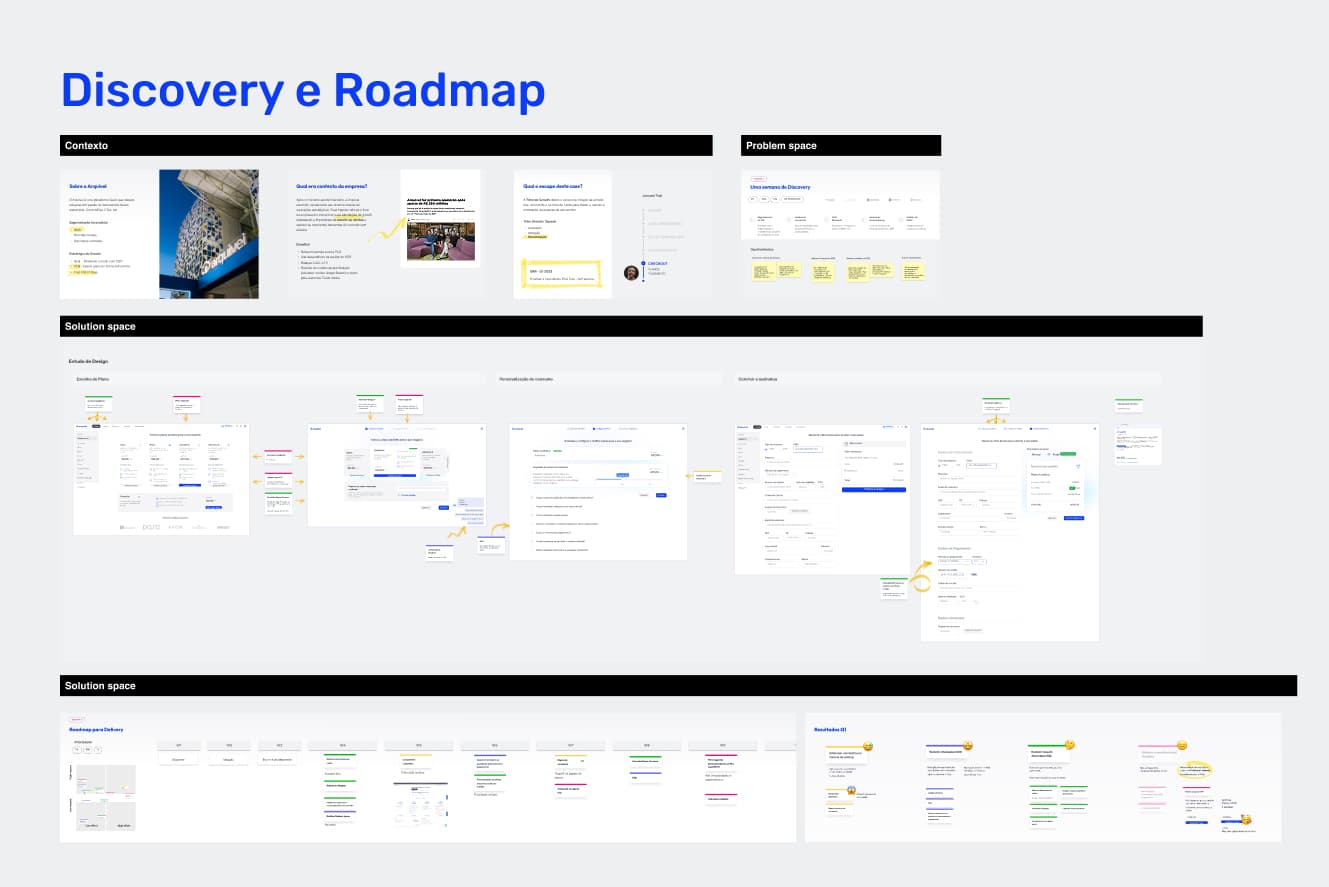
The process was conducted under clear time constraints: the solution definition happened within a quarter planning week, requiring focus on quick decisions, cross-area alignment, and intensive use of existing data. More than an extensive discovery, the work was structured as a concentrated cycle of understanding, definition, and validation.
Data and behavior analysis
Quantitative data collection to identify usage patterns, drop-off points, and low progression within the trial.
Interviews and qualitative inputs
Conversations with Customer Concierge and sales teams to understand real barriers faced by users.
Problem and opportunity definition
Synthesis of learnings to identify key activation gaps regarding technical effort and value understanding.
Prototyping and validation
Exploration of solutions for journey reorganization and decision support, with stakeholder validation.
Iterative testing and adjustments
Continuous refinement of solutions based on feedback and monitoring of internal activation flows.
Results
Average ticket
MRR increase with the introduction of volumetry into the pricing model, connecting usage to plan value proposition.
Trial support calls
Significant reduction in SDR calls during the trial period following the introduction of support layers.
Trial NPS
Improved NPS at the end of the trial experience, reflecting greater value clarity and less frustration.
Activation funnel
Reduction in funnel leaks, even without expressive gains in final subscription conversion.
Trial progression
Greater progression to the Aha moment within 7 days, indicating better alignment between the journey and product value.
What this project taught me
Short trial requires focus
In reduced periods, it's essential to guide the user explicitly to actions that lead to minimum value (Aha moment).
Time as a structural element
Limited time should not just be a restriction, but an element that dictates experience prioritization.
Dispersion reduction
Activation directly depends on removing noise and attention competition during the first contact with the product.